Stories
Between Memory and Landscape
Mária's landscapes are never simple records of a place. Through colour, texture and instinctive brushwork, the visible world becomes something remembered, felt and quietly transformed.
The paintings of Bodrogi Mária do not attempt to describe a landscape with photographic precision. They hold on to something less exact, but perhaps more enduring: the way a place remains in the mind after we have left it.
Forests, hills, lakes and winding paths return throughout her work. These places are recognisable, yet their details are never fixed too tightly. Trees emerge through quick vertical marks, foliage is built from layered strokes of colour, and distant hills dissolve gently into the sky.
Mária simplifies what she sees without emptying it of character. A single pine can become the centre of a winter landscape. A pale path can lead the eye into a dense forest. The reflection on a lake may occupy almost half the canvas, turning the scene into a quiet study of light and colour.
Her palette changes with the seasons. Spring and summer appear in fresh, varied greens beneath clear blue skies. Autumn brings ochre, muted gold, brown and deep violet. In the winter paintings, colour is reduced to cool greys, soft blues and the dark lines of bare trees, occasionally interrupted by the green of a pine or the warmth of vegetation still visible beneath the snow.
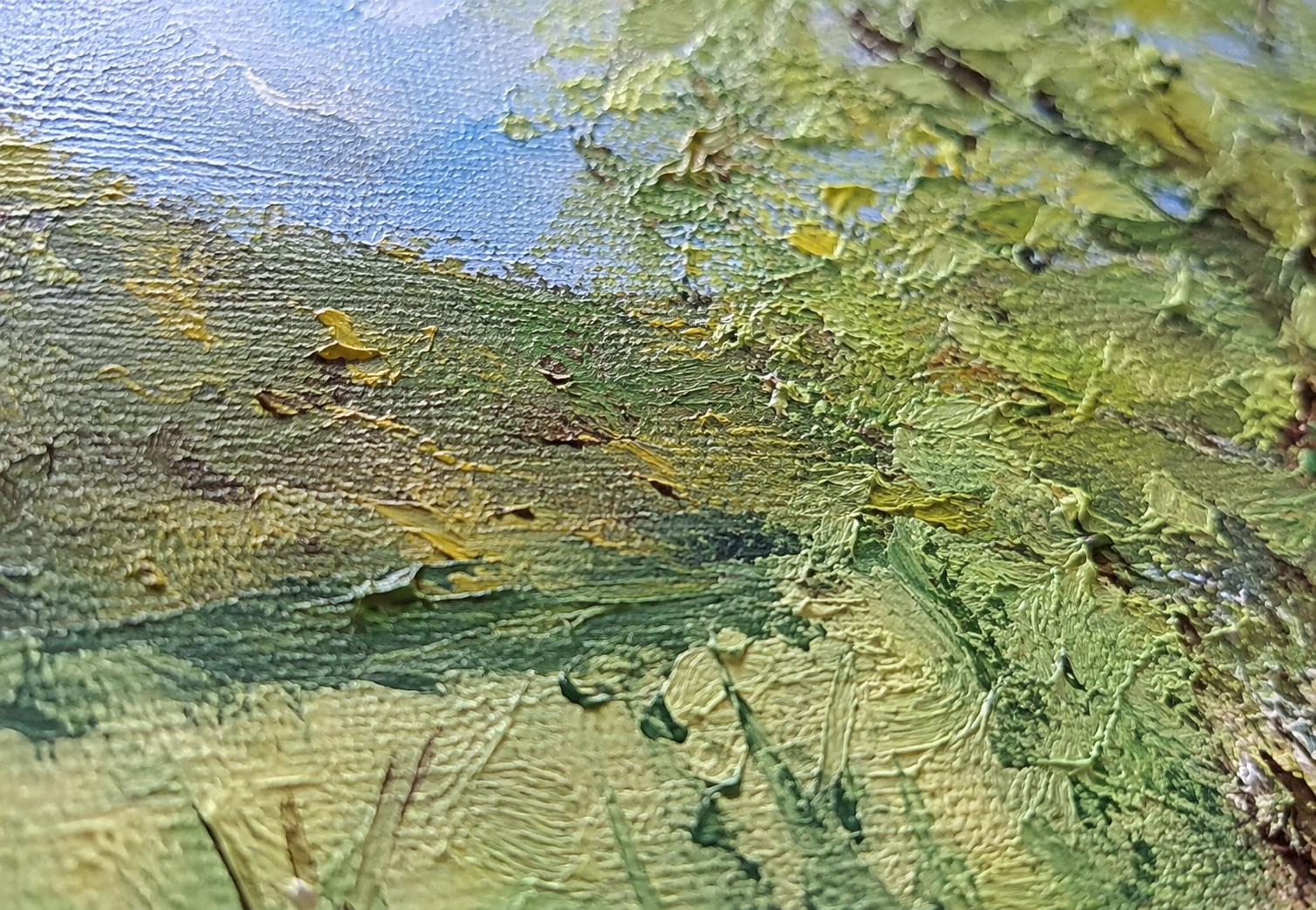
These colours are rarely uniform. Greens contain traces of yellow, grey and brown; water reflects pink, blue, silver and earth tones. Rather than filling each area with a single shade, Mária allows colours to meet and remain visible beside one another.
The surface of the paintings is an important part of their character. Brushstrokes are not hidden. Thick marks form slopes, tree trunks and uneven ground, while broader, softer strokes create open skies and still water. In places, the texture of the canvas remains visible beneath the paint. The landscape feels constructed by hand rather than polished into an illusion.
There are no grand monuments or dramatic events in these scenes. Human figures are absent. Instead, our attention is drawn towards a bend in a path, the edge of a forest, the reflection of trees or the particular colour of a hillside.
Again and again, the compositions invite us inward. Roads disappear between trees, waterways narrow towards the horizon, and openings in the landscape suggest that something continues beyond the edge of the canvas.
This may be why the paintings can feel familiar even when we have never visited the places they depict. They do not depend on recognising a precise location. They recall a more personal kind of geography: a forest walked through long ago, the colour of water beneath an autumn sky, or the silence of fresh snow.
They exist somewhere between observation and recollection — between the landscape as it appeared and the landscape as it stayed with her.